Quick Summary: Core Rules for Choosing a Tilting Puzzle Table
A tilting puzzle table represents the single most effective ergonomic upgrade for adult jigsaw enthusiasts. Working for hours hunched over a flat dining table or coffee table forces the head forward into unnatural angles, leading to painful neck stiffness, trapezius spasms, and mid-back fatigue that cuts enjoyable puzzle sessions short.
The ALL4JIG puzzle range includes workspaces for different room sizes and puzzle routines.
Bending forward over a flat 0° tabletop induces 45° to 60° of forward cervical flexion, multiplying gravitational moment arms and placing an effective load of 45 to 60 lbs on cervical spine extensor muscles.
Tilting the working plane between 20° and 35° elevates the puzzle surface toward the natural visual horizon, reducing neck flexion to 15°–20° and slashing cervical spinal load to just 12–15 lbs—delivering a greater than 70% reduction in sustained spinal torque.
Key Takeaways: Choosing an Ergonomic Tilting Puzzle Table
-
Relieve Cervical Spine Strain: Elevating the puzzle board eliminates the 45 to 60 lbs of cervical torque caused by flat table hunching.
-
Target the 25°–30° Incline Sweet Spot: Setting the table to a 20°–35° tilt lowers cervical load to 12–15 lbs, achieving over 70% spinal strain reduction while maintaining comfortable hand reach.
-
Insist on Notched Ratchet Brackets: Avoid slipping thumbscrews; choose positive-locking steel or hardwood ratchet detent bars that support over 25 lbs of vertical forearm leaning force.
-
Demand High-Friction Flannel or Baize: Bare wood dumps pieces onto your lap past 12°; high-traction microfiber flannel or wool baize (friction coefficient 0.65–0.78) holds pieces securely up to 35°.
-
Verify Retaining Lip Height: Ensure the bottom edge features a 10 to 15 mm chamfered retaining lip to catch border pieces without compressing forearm nerves.
The Ergonomics of Puzzling: How Tilting Reduces Cervical Spine Torque by 70%
Most hobbyists blame poor lighting or chair cushions for fatigue, but clinical biomechanics proves that neck flexion angle is the true culprit behind tabletop discomfort.
When sitting upright with your head in neutral alignment, your cervical spine supports approximately 10 to 12 lbs of head weight. However, bending forward over a flat 0° desk surface forces the neck into 45° to 60° of downward flexion, causing the gravitational lever arm to magnify effective head weight to a punishing 45 to 60 lbs of continuous muscle strain.
Over a two-hour session, this sustained tension starves posterior cervical muscles of oxygen, resulting in tension headaches, burning shoulder knots, and lower neck soreness.
Tilting the puzzle working plane between 20° and 35° brings the visual focal area up toward eye level, allowing the neck to relax into an easy 15°–20° flexion angle that reduces cervical spinal load to just 12–15 lbs.
This dramatic 70%+ reduction in sustained spinal torque transforms puzzling from a physically taxing posture into a restorative, pain-free pastime.
Tilt Angle Hierarchy: Matching Incline Settings to Puzzle Tasks
A superior tilting puzzle table does not lock you into a single slant. Different stages of assembly demand different working angles to balance visual alignment against hand ergonomics.
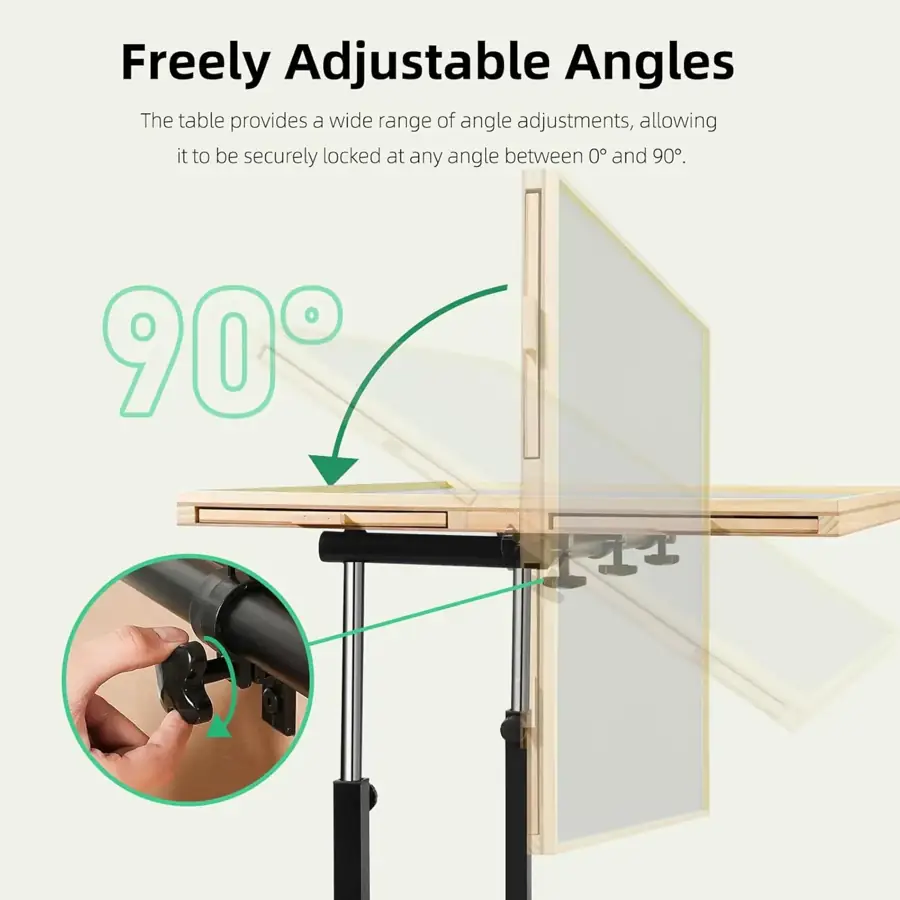
Multi-angle ratchet presets provide three distinct functional incline tiers: a shallow 15°–20° slant optimized for sorting trays and perimeter border assembly, a 25°–30° angle representing the ideal sweet spot for general interior assembly, and a steep 35°–45° incline tailored for standing work or intricate upper-quadrant detail.
Tilt Angle Settings, Friction Retention & Task Matching Comparison Matrix
| Incline Setting | Primary Assembly Task | Neck Flexion Angle & Relief | Piece Stability Threshold | Recommended Surface Lining |
|---|---|---|---|---|
| 15° to 20° Tilt | Sorting loose pieces & assembling border frame | 25°–30° flexion (moderate relief) | Stable on low-pile felt | Microfiber flannel or felt |
| 25° to 30° Tilt | General interior puzzle assembly (Sweet Spot) | 15°–20° flexion (>70% torque relief) | Requires high-friction baize | Brushed flannel or dense baize |
| 35° to 45° Tilt | Standing assembly & fine brushwork detail | 0°–10° flexion (standing eye-level) | Requires retaining bottom lip | Heavy wool baize + lip support |
Setting your board to 25° provides the sweet spot where pieces remain completely stable while your neck remains comfortable throughout extended sessions.
Support Hardware Engineering: Notched Ratchet Brackets vs. Slipping Friction Knobs
The mechanical heart of any tilting table is its easel prop mechanism. When reaching across a 30-inch board to place a piece in the top corner, puzzlers naturally rest their forearms on the bottom edge.
Structural load testing demonstrates that multi-position steel or hardwood ratchet easel brackets featuring positive gravity detent notches easily withstand over 25 lbs of vertical forearm leaning force without slipping, whereas generic friction screw knobs slip and collapse under just 14 lbs of downward pressure.
A slipping bracket not only shocks your wrists but can send hours of delicate puzzle work crashing to the floor. Always look for deep, positive-locking ratchet teeth cut into heavy-gauge steel or solid hardwood.
Compare the available ALL4JIG puzzle tables against the measurements and features discussed here.
Surface Friction Science: Why Flannel and Baize Beat Bare Wood on Inclines
Tilting a puzzle board introduces gravity into the assembly equation. If the surface lacks sufficient static friction, loose pieces will slide toward the bottom edge, creating frustrating piece avalanches.
Bare polished hardwood and lacquered veneers have a very low static friction coefficient (mu_s = 0.20 to 0.25), causing cardboard puzzle pieces to slide and avalanche once the incline exceeds 12° to 14°.
In contrast, surfaces lined with premium brushed microfiber flannel or dense wool baize provide a high static friction coefficient of 0.65 to 0.78, holding loose cardboard pieces firmly in place against gravitational shear up to tilt angles of 33° to 38°.
This high-traction fabric allows you to tilt the board aggressively without worrying about loose sorted sections sliding down.
Retaining Rim Engineering: 10–15 mm Bottom Lip Security and Forearm Comfort
Even with high-friction fabric, a sturdy bottom retaining rim is vital to anchor assembled sections and catch stray pieces when working near the lower border.
According to ergonomic furniture standards, tilting puzzle workstations require a raised bottom retaining lip between 10 and 15 mm (0.4 to 0.6 inches) in height with a bullnose or chamfered profile to prevent multi-piece border cascades while protecting forearm nerves from contact pressure.
A lip lower than 10 mm allows assembled borders to slide over the edge, while an unchamfered edge taller than 18 mm digs painfully into wrists, compressing the ulnar nerve. A smoothly rounded 12 mm wooden lip delivers the perfect balance of security and contact comfort.
Tabletop Sizing: Fitting Standard 1,000-Piece Puzzles vs. Oversized Formats
Before choosing a tilting table, verify that its interior usable dimensions match your puzzle preferences. Not all 1,000-piece puzzles are created equal.
Standard European 1,000-piece puzzles from Ravensburger measure 27.6 in × 19.7 in (70 cm × 50 cm), requiring an interior working area of at least 28" x 20" inside the perimeter lips.
Standard American cuts from Buffalo Games measure 26.75 in × 19.75 in, fitting comfortably inside standard 27.5" x 20.5" tilting board frames.
However, popular oversized puzzles from White Mountain feature larger piece cuts measuring 30 in × 24 in (76.2 cm × 61 cm), requiring an oversized 1,500-piece rated tilting table (at least 25" x 31" internal space) to avoid border overhang.
Always measure your favorite puzzle boxes before buying to ensure your preferred brand fits inside the easel's retaining border.
Buyer's Evaluation Checklist: 5 Must-Check Mechanical Features Before Purchasing
When evaluating tilting puzzle tables, use this five-point mechanical and ergonomic checklist to ensure lasting quality:
-
Ergonomic Incline Range: Verify that the table offers a 20° to 35° incline preset, providing over 70% cervical spine torque reduction by lowering neck load from 45–60 lbs down to 12–15 lbs.
-
Positive Notched Ratchet Bracket: Ensure the tilt support uses notched steel or hardwood ratchet detents that resist over 25 lbs of vertical forearm leaning force rather than slipping friction screws.
-
High-Friction Fabric Lining: Look for brushed microfiber flannel or dense wool baize with a friction coefficient of 0.65 to 0.78 to keep cardboard pieces stationary up to 35°.
-
Chamfered 10–15 mm Retaining Lip: Check that the bottom lip measures 10 to 15 mm high with rounded bullnose edges to prevent piece cascades without pinching forearm nerves.
-
Adequate Usable Surface: Confirm interior dimensions of at least 28" x 20" for standard 1,000-piece puzzles, or 25" x 31" if you assemble oversized White Mountain designs.
For comprehensive guidance across all tabletop formats, consult our complete puzzle table buying guide, or evaluate drawer storage options in our dedicated review of the best puzzle tables with drawers.
For the next step, read Best Folding & Portable Puzzle Tables: 2026 Space-Saving Buyer's Guide.